Introduction
Construction projects often require reliable temporary support during critical stages, including concrete pouring, formwork installation, and structural reinforcement. The quality of support equipment directly affects construction safety, working efficiency, and project progress.
Among various temporary support solutions, adjustable steel props are widely used because they offer flexible height adjustment and stable load-bearing performance. However, selecting the right steel prop requires careful consideration of several factors, including material quality, load capacity, adjustment range, and surface protection.
This guide explains the key factors buyers should evaluate when choosing adjustable steel props and helps contractors find suitable support solutions for different construction requirements.
What Is a Steel Prop and Why Is It Important in Construction?
A Reliable Temporary Support for Construction Work
A steel prop is a vertical support used to carry temporary loads during construction. It is commonly installed beneath concrete slabs, beams, and formwork before the permanent structure reaches sufficient strength.
Compared with traditional timber supports, steel props provide better height adjustment and more stable load control. Workers can extend or shorten them according to different site conditions. This flexibility helps improve installation efficiency while maintaining safe support.
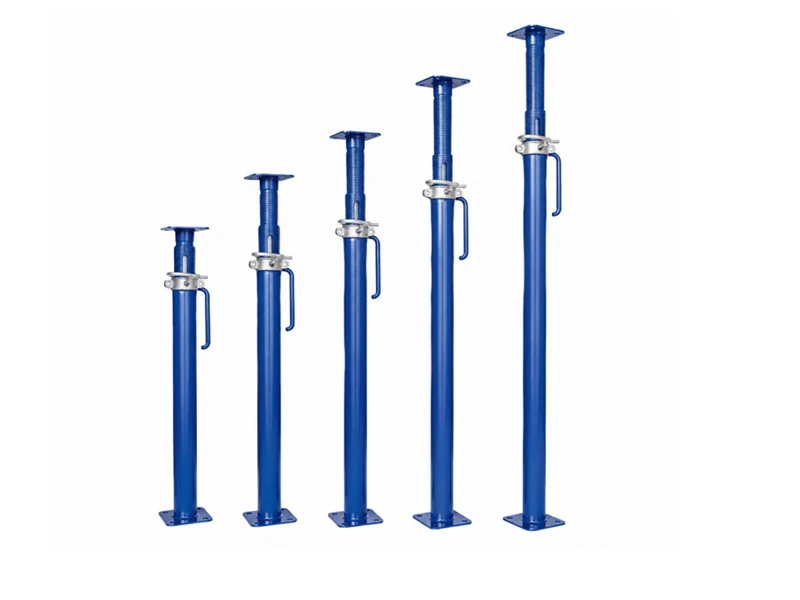
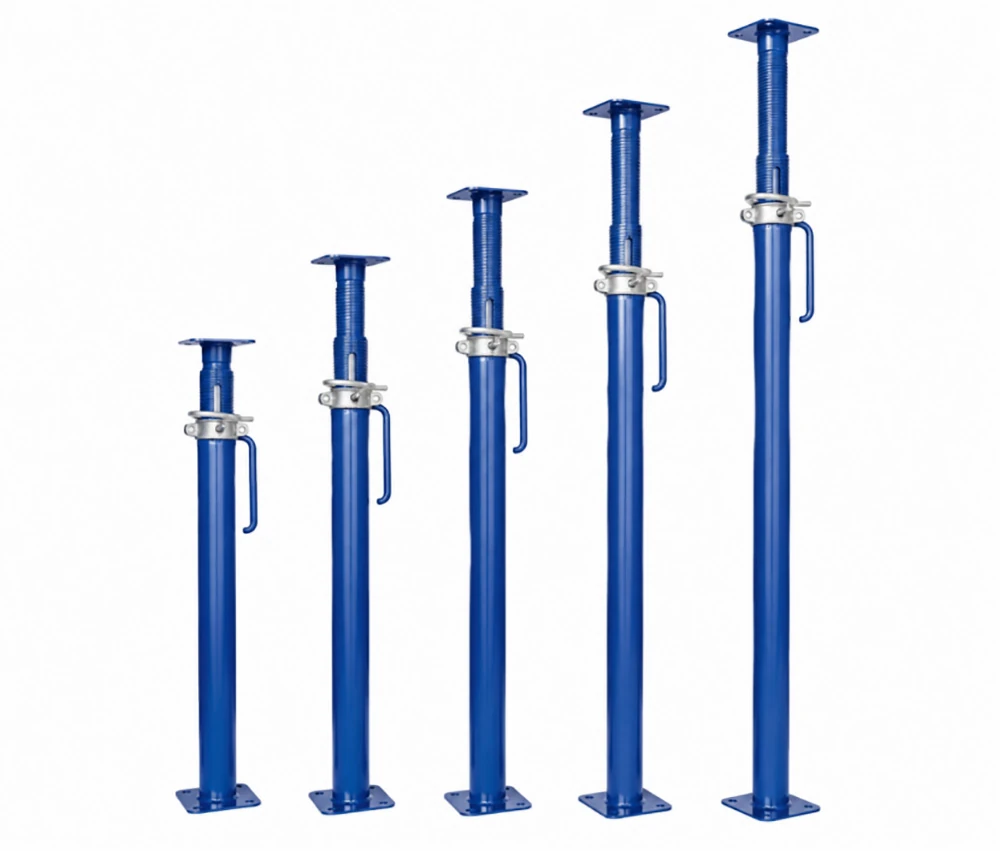
A well-designed adjustable steel prop usually consists of several key components, including inner and outer tubes, adjustment nuts, base plates, and fork heads. Each part contributes to load support and improves overall safety during construction.
How Does the Structure of a Steel Prop Improve Performance?
The structure of a steel prop directly influences its stability and service life. Most adjustable steel props use a telescopic design with inner and outer tubes. Workers can adjust the height through the threaded mechanism to meet different support requirements.
High-quality props are commonly manufactured with Q235 or Q345 low-alloy high-strength structural steel. These materials provide strong axial support even when the prop is fully extended. The adjustment thread also allows precise height control, which helps workers complete installation more efficiently.
The base plate is another important component. A stamped steel plate, such as 120×120×4 mm or 150×150×5 mm, helps distribute loads evenly across the ground surface. At the top of the prop, the fork head supports wooden beams or H20 beams, creating a stable connection with the formwork structure.
Why Are Steel Props Important for Construction Safety?
Construction sites often experience changing loads and complex working conditions. A suitable temporary support solution helps reduce movement and improves overall stability.
For projects where the support height exceeds 3 meters or where lateral forces may occur, such as wind or vibration, a tripod can be added to improve stability. It helps keep the steel prop in position and reduces the risk of movement during operation.
By understanding the structure and working principles of steel props, contractors can make better purchasing decisions. The right choice improves construction efficiency and provides safer support throughout the building process.
Why Are Adjustable Steel Props Better Than Traditional Supports?
Temporary supports play an important role in construction projects. Although timber supports are still used in some applications, their performance can vary due to moisture, knots, and aging. This makes it difficult to maintain consistent support strength.
Compared with traditional timber supports, adjustable steel props provide better durability, flexibility, and long-term value. They can be reused multiple times and adjusted for different construction requirements.
How Do Steel Props Help Reduce Costs?
Steel props offer long-term economic benefits because they can be reused after proper maintenance. Although their initial cost may be higher than timber supports, the cost per use becomes lower over multiple projects.
For example, a medium-sized residential project requiring 200 supports may spend about $2,950 on timber supports due to replacement costs and higher labor requirements. By using reusable adjustable steel supports, the total cost may be reduced to around $500 through repeated use and faster installation.
Why Do Adjustable Designs Improve Efficiency?
The adjustment nut allows workers to quickly change the support height according to site conditions. This reduces installation time and eliminates the need for cutting or replacing support materials.
In addition, steel props are manufactured with standardized dimensions and controlled material quality. They provide more consistent performance, making them suitable for large construction projects where safety and efficiency are critical.
Why Choose Friend Steel Pipe for Adjustable Steel Props?
Friend Steel Pipe provides adjustable steel props designed for different construction applications. With flexible specifications, strict quality control, and customization options, the company helps contractors select suitable support solutions based on project requirements.
Certified Manufacturing and Quality Management
Quality control is essential for construction support products. Friend Steel Pipe follows internationally recognized management standards to improve manufacturing reliability and product consistency.
The company has obtained:
- ISO 9001
- ISO 14001
- ISO 45001
These certifications demonstrate the company’s commitment to quality management, environmental responsibility, and workplace safety throughout the production process.
Flexible Steel Prop Specifications for Different Projects
Different construction projects require different support solutions. Friend Steel Pipe provides adjustable steel props with various material grades, sizes, and height ranges to meet different application needs.
Key specifications include:
| Item | Options |
| Material | Q235 or Q345 steel grades, customizable according to project requirements |
| Outer tube diameter | 48 mm, 56 mm, 60 mm, or 76 mm |
| Inner tube diameter | 40 mm, 48 mm, or 63 mm |
| Wall thickness | 1.6 mm–2.5 mm, customizable |
| Adjustable height | 1.8–3.2 m, 2.0–3.5 m, 2.2–4.0 m, 3.0–5.0 m, and other ranges available |
| Working load capacity | About 15–25 kN for light-duty models and up to 30–50 kN for heavy-duty models, depending on design and working conditions |
| Base plate size | 120×120 mm or 150×150 mm |
| Surface treatment | Painting, pre-galvanizing, or hot-dip galvanizing |
This flexibility allows contractors to choose suitable steel props based on load requirements, working height, and site conditions.
Solutions for Challenging Construction Environments
Construction sites may face demanding conditions, including coastal humidity, strong winds, earthquakes, and heavy loads. In these situations, selecting the right product configuration is essential.
For high-humidity or coastal areas, hot-dip galvanized steel props with a zinc coating of at least 50 μm provide better corrosion resistance. The zinc layer protects the steel substrate through cathodic protection, even when minor surface damage occurs.
For projects in strong wind or earthquake zones, additional stability measures can improve safety. Tripods help increase lateral stability, while horizontal linkages between supports reduce movement caused by external forces.
For heavy-load applications, contractors can select thicker tubes and reinforced base plates. Load testing before shipment also helps confirm that products meet project requirements.
Case Study: Adjustable Steel Props for a High-Rise Residential Project in the Middle East
Project Challenges
A client was constructing a 25-story residential building in an arid region of the Middle East. Traditional timber supports resulted in slower installation and inconsistent load performance. The project also required support products that could withstand high temperatures and harsh environmental conditions, as summer surface temperatures exceeded 50°C.
Customized Steel Prop Solution
To solve these challenges, the project adopted adjustable steel props with a 60.3 mm outer tube, a 48.3 mm inner tube, and an adjustable height range of 2,000–3,500 mm. Hot-dip galvanizing was applied to improve corrosion resistance and protect the supports during long-term use.
The lightweight design, with each prop weighing approximately 10–17 kg, allowed workers to install and adjust the supports more efficiently.
Project Results
The adjustable steel props reduced single-floor support installation time from 3 days to 1.5 days and lowered labor costs by approximately 35%.
During the 12-month construction period, no rust problems or adjustment failures occurred. The project was completed two weeks ahead of schedule, and the client selected the same solution for three additional projects.
FAQ
Q1. How do I choose the right steel prop model based on floor height?
The adjustable height range should match the actual floor height. Choose a steel prop model that can safely cover the required support height while maintaining sufficient load capacity.
Q2. What is the difference between hot-dip galvanized and pre-galvanized steel props?
Hot-dip galvanized steel props have a zinc coating of ≥50 μm, which provides stronger corrosion resistance. They are suitable for humid areas, coastal projects, and applications with higher durability requirements.
Pre-galvanized steel props have a smoother surface, which helps reduce cement adhesion and makes nut adjustment easier. They are commonly used for short-term projects or dry environments where cost efficiency is a priority.
Q3. When should a tripod be used with a steel prop?
A tripod is recommended when the support height exceeds 3 m or when lateral forces, such as wind, vibration, or earthquakes, may occur. It improves the lateral stability of the support and helps prevent movement.
Q4. What should I do if the adjusting nut gets stuck?
A stuck nut is usually caused by cement buildup or corrosion. Regular cleaning and applying anti-rust oil can help prevent this issue.
If the nut becomes stuck, use a suitable rust remover and loosen it carefully. Avoid applying excessive force, as this may damage the adjustment mechanism.
Q5. Can adjustable steel props be installed at an angle?
No. Adjustable steel props are designed to support vertical axial loads only. For diagonal support applications, a dedicated push-pull prop should be used.
Q6. What is an adjustable steel prop?
An adjustable steel prop is a temporary vertical support that can be extended or shortened to support formwork, concrete slabs, beams, and other temporary structures during construction.
Q7. How is the height of a steel prop adjusted?
The height is adjusted through telescopic inner and outer tubes. After rough positioning with the locking pin, workers can use the threaded adjustment nut for precise height control.
Conclusion
Choosing the right steel prop is important for construction safety and efficiency. Buyers should evaluate key factors such as load capacity, material grade, height adjustment range, and product quality before making a decision.
Reliable adjustable steel props provide stable temporary support for different construction environments. They also help reduce installation time and improve long-term project value.
For contractors and distributors looking for dependable scaffolding steel props, working with an experienced manufacturer can ensure consistent product quality and professional support.
Contact Friend Steel Pipe today to discuss customized steel prop solutions for your construction projects.